CAT5E Input Box
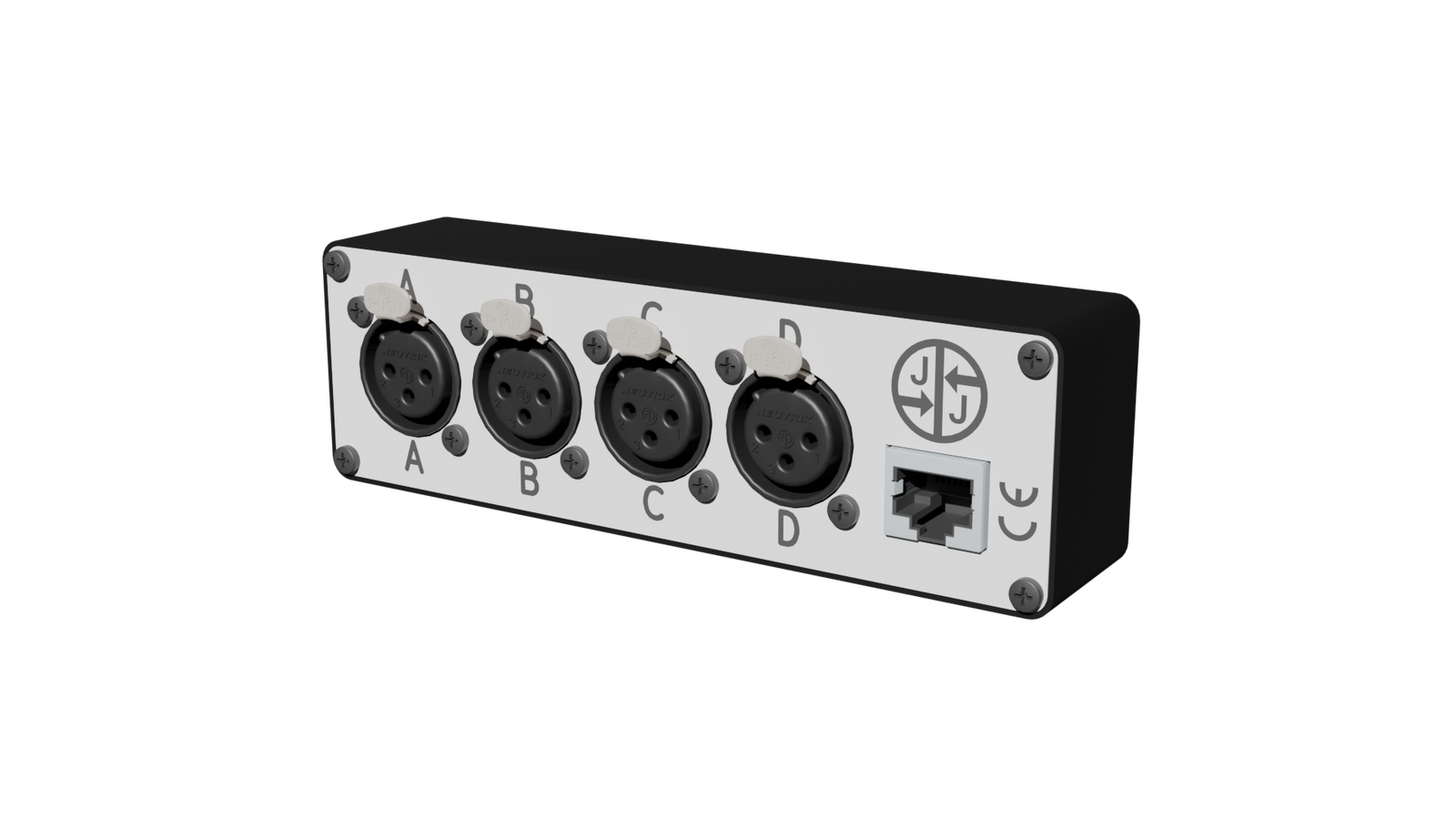
Overview
A simple, direct way to bring audio in over standard CAT5E cable. The box breaks the cable's four balanced differential pairs out to four female XLR inputs, so mics or other balanced sources patch straight into it on the input side of a run.
Because it rides on ordinary network cable, runs are cheap, light, and easy to source or replace anywhere — no proprietary multicore, no specialist connectors on the cable itself.
Why CAT5E works for balanced audio
CAT5E is specified for up to 100 MHz signalling — enough for Gigabit Ethernet — and that only works if every twisted pair holds tightly controlled, low series inductance and low parallel capacitance along its length. Audio only needs to get from roughly 20 Hz to 20 kHz: about four orders of magnitude below what the cable is built for.
At audio frequencies, that inductance and capacitance are effectively negligible — each pair behaves like a plain, low-loss conductor. The same tight, consistent twist that keeps crosstalk under control at gigabit data rates is even better at rejecting hum and RF pickup at audio frequencies, which is exactly what balanced wiring is supposed to do. In short, CAT5E is wildly overqualified for the job — which is what makes it such a good, cheap way to carry it.
Each channel is wired to one of the cable's four actual twisted pairs, following the standard T568A/T568B pin groupings (pins 1&2, 3&6, 4&5, 7&8) rather than a straight run across the connector. A balanced pair only rejects hum and RF because its + and − conductors stay twisted together along the full length of the cable — splitting a channel across two different physical pairs would throw that benefit away. Following the T568 groupings keeps every channel's twist intact, end to end.
Specifications
- Four female XLR inputs (pairs A–D)
- Runs over standard CAT5E cable
- Balanced mic/line-level signal on all four pairs
- Passive design — no external power required
Downloads
- User manual & wiring guide (PDF) Coming soon
Compliance & documentation
- Declaration of Conformity (CE) Coming soon
- EMC test report Coming soon
- RoHS declaration Coming soon
- CAD / STEP model Coming soon
Status
In development — not yet available for order.